

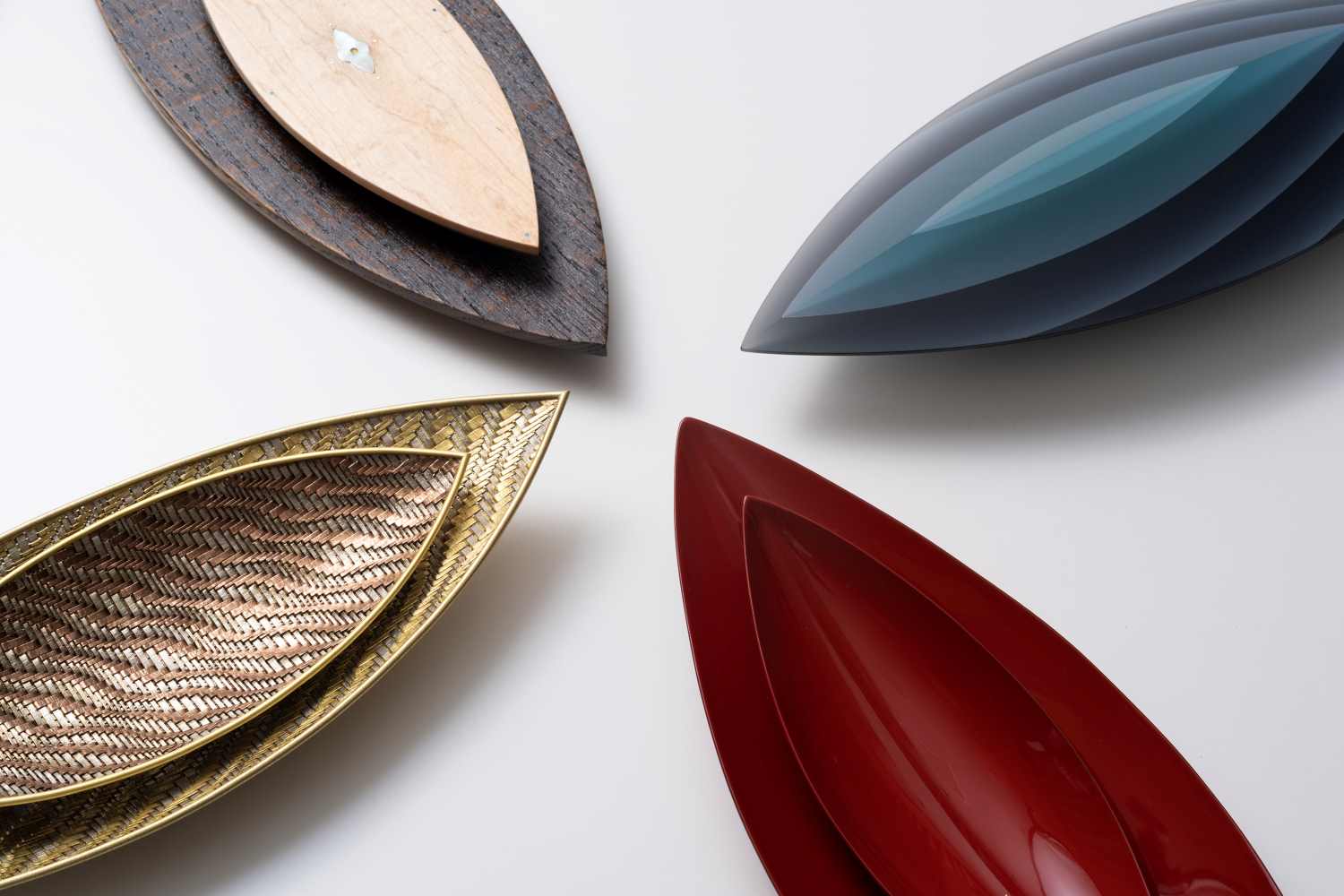
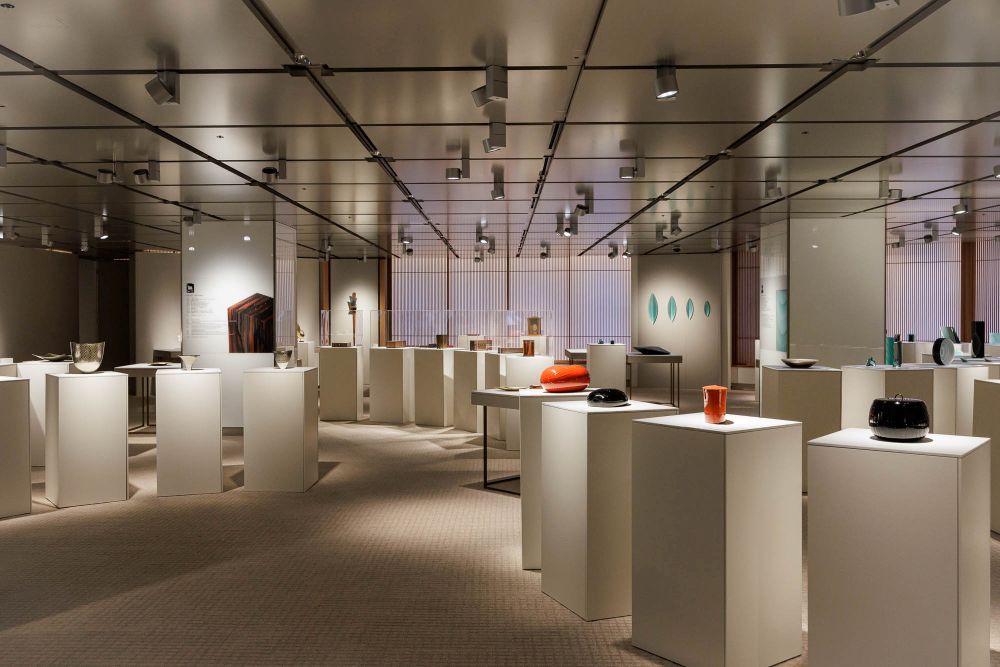
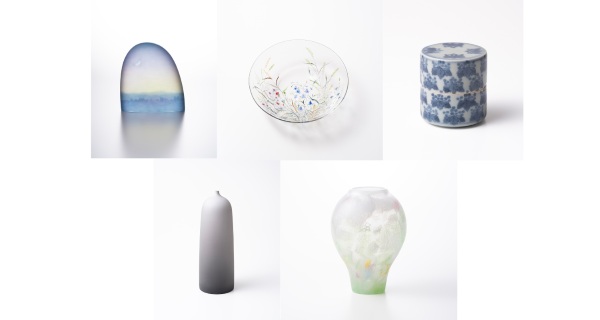
8The Seiko House Hall on the 4th floor of Seiko House, which reopened at the end of the month after renovations, is currently hosting "Four-Petal Flower Fragrance II: Glass, Lacquer, Metal, Wood." Approximately 100 works by four artists, each utilizing the unique characteristics of their materials and employing their own distinctive techniques, adorn the newly renovated venue. Collaborative works reminiscent of the exhibition title, "Four-Petal Flower," are also featured. This exhibition offers an opportunity to encounter the evolved forms of materials and techniques that have long been used in traditional Japanese crafts.
The gentle natural light contained within layers of glass ──Glass by Yukako Kojima──
Glass contains light. Depending on the viewing angle, the intensity and color of that light subtly change. To be precise, it is reflected light. However, the layers of glass receive ambient light, creating subtle color gradations, and when these gradations overlap, the glass emits a soft glow, as if it were containing light itself.
The technique used in Yukako Kojima's work is "laminated glass." This method involves bonding multiple sheets of glass, the kind used in building materials such as windows, together with adhesive, then cutting and shaping them to reveal the cross-section.
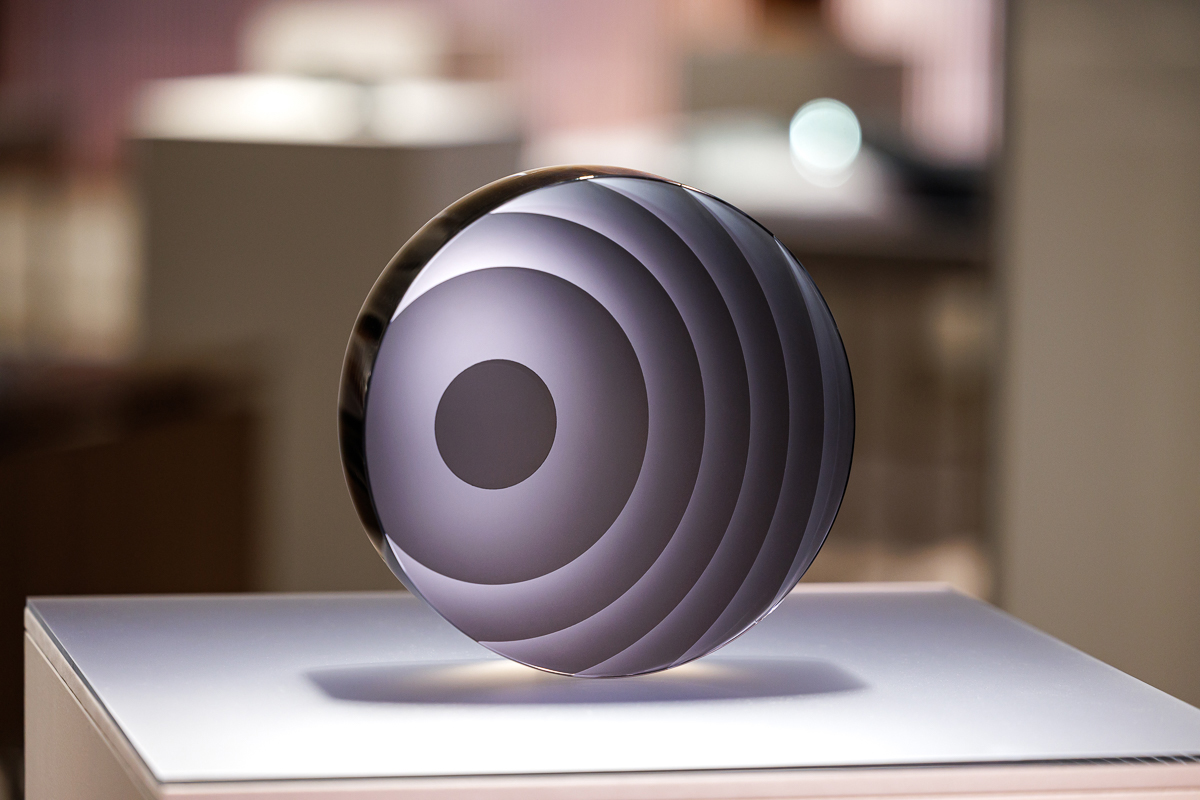
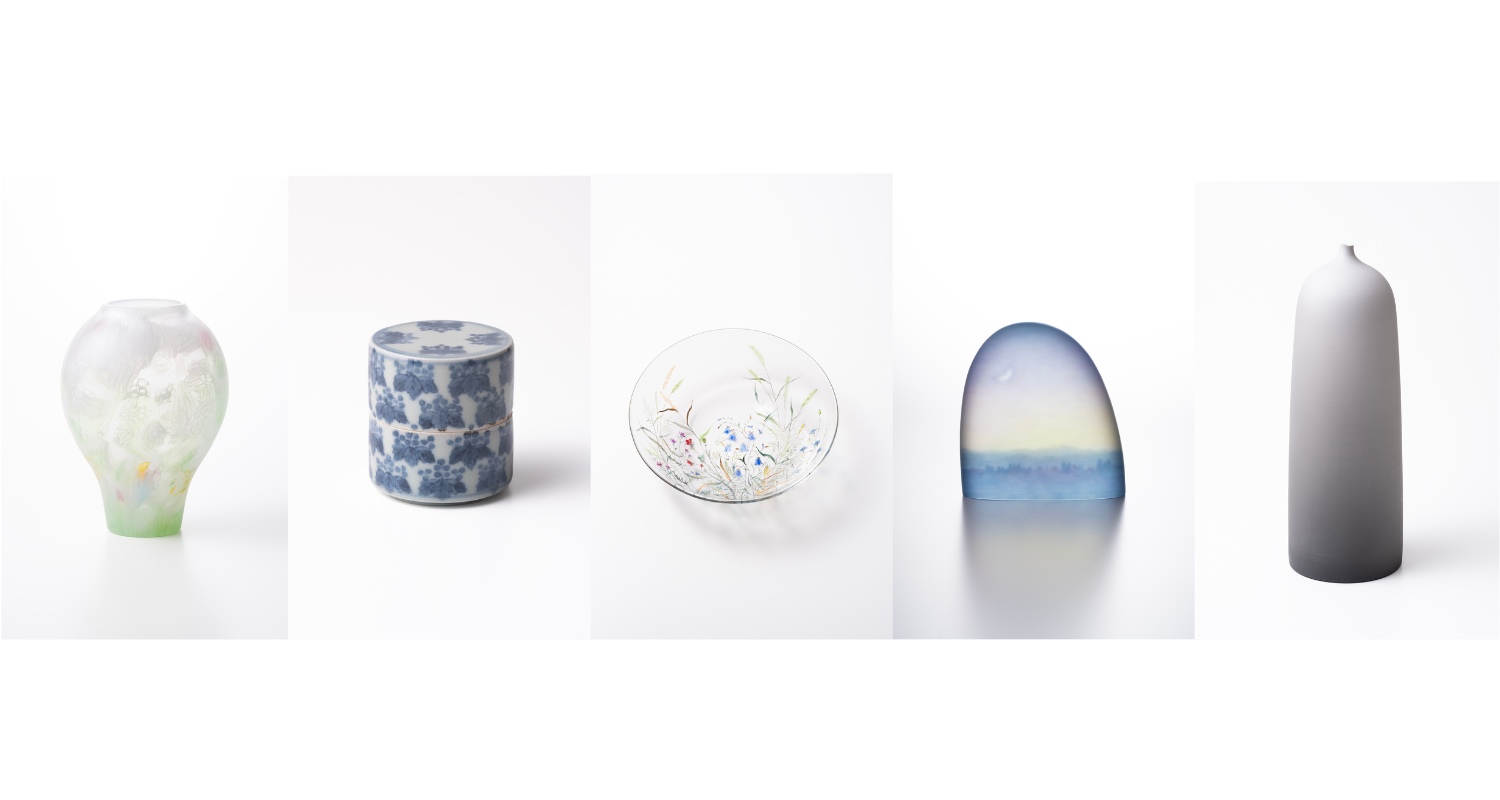
Layers of Light ─Moon─ ♯4 w24×d7×h24cm
"We anticipate the pattern of the layered cross-sections beforehand, create design drawings, and then begin production. Initially, it was a continuous process of trial and error, but recently, we've become able to predict the final result to some extent. Among the sheet glass, there is a type called 'heat-reflective glass,' which has a metal coating on its surface to reflect heat. When we use this type of glass, the overlapping edges of the glass pieces sparkle as if they are emitting light themselves."
As Kojima's words suggest, the sharp lines of light running through the overlapping areas tighten the overall work, elevating it to a state of tension.
An intellectual atmosphere permeates the geometrically composed works.
Having loved making things since childhood, Kojima chose to attend an art university without hesitation. There, she chose glass. She studied a variety of glassmaking techniques, including blown glass, polished glass, laminated glass, and cast glass. Ultimately, she chose laminated glass.
"Compared to glassblowing, it takes more time and effort, and there are limitations on shape and color. But there's a certain enjoyment in thinking within those limitations. The process of creating a precise design beforehand and then producing based on it is geometric, and since I was originally good at science and math, it might have suited me."
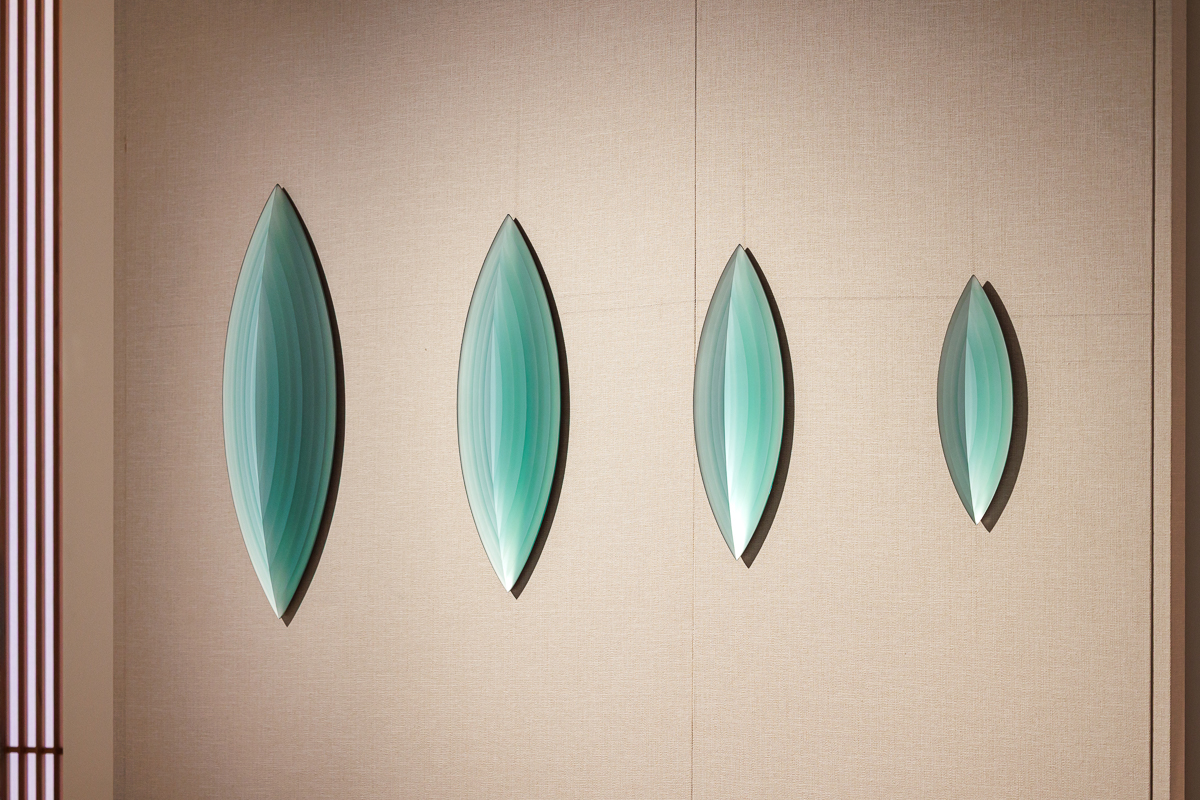
Layers of Light ─Forest─ (partial) w19×d6.5×h60cm~w10×d3.5×h30cm
Indeed, the works, composed of multiple layers of glass plates arranged in a meticulous and geometric manner, exude an intellectual atmosphere reminiscent of the world of science and mathematics. However, as Kojima says, the process of completing them requires an enormous amount of time and effort.
The majority of the work is spent grinding. Through hours of polishing, the glass acquires a hard, transparent quality and begins to glow as if it contains light. For large pieces, the initial block of glass weighs tens of kilograms. This is then ground down with a grinder and meticulously polished, ultimately reducing its weight to less than half. It is truly a process that requires time, effort, and physical strength.
"It's truly hard work. But after going through that hard work, when the artwork takes on expressions not only that I had envisioned, but also expressions I never expected, and those expressions emerge as light, all the hardship of the work disappears."
The large artworks displayed in the venue seemed to emit not only light, but also a noble energy.
The endlessly soft curves made possible by dry lacquer ──Urushi (lacquer) artist, Mina Okui──
Mina Okui's works are warm and inviting. The gentle, soft curves are incredibly soothing to the viewer. Her technique is dry lacquer, a traditional lacquer technique that was used in ancient times, including for Buddhist statues in the Nara period. She applies hemp cloth to a plaster mold with lacquer, and once it has thickened, she removes the mold to create the base, onto which she then applies layers of lacquer.
"If you use cotton cloth, the lacquer penetrates too deeply into the fibers, causing it to crack when it dries. Linen cloth, however, doesn't allow the lacquer to penetrate all the way to the core, resulting in just the right balance and creating flexibility. That's why linen cloth has been used for dry lacquer since ancient times. This is surely the wisdom of our ancestors. Dry lacquer is light, strong, and can withstand a certain degree of impact."
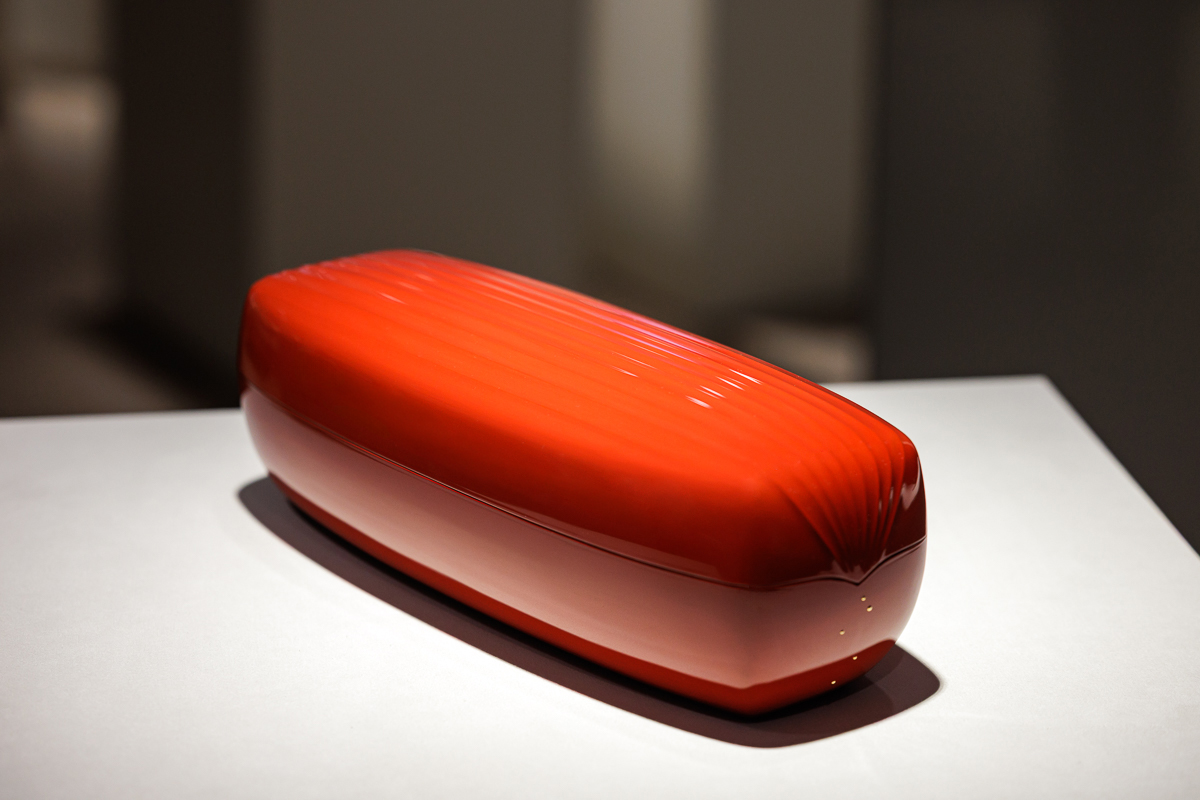
Dry lacquer box "Drip" W34×D13.5×H11.5cm
The form of a work is determined when the mold is made from clay or plaster. It is such an important initial step, but Okui says that she enjoys that process.
"The process of working with my hands while imagining the finished product—thinking, 'Should I make this part a little more inflated?' or 'Should I make this part a little rounder?'—is very enjoyable. I finish the mold by carving the plaster."
As Ms. Okui herself enjoys the process and allows her imagination to run wild, soft and flowing curves are created.
A delicate vermilion that enhances the softness of the curves.
Another characteristic of Okui's work is the delicate shade of vermilion lacquer, which harmonizes with the soft curves and further enhances their gentleness. The slightly yellowish vermilion lacquer is both vibrant and gentle, and unlike the heavy, traditional vermilion, it exudes a light and even modern atmosphere.
Okui also creates works using black lacquer, which possesses a deep, lustrous sheen. In one corner of the venue, works using black lacquer and vermilion lacquer are displayed alternately, a clever arrangement that makes each color tone stand out even more.
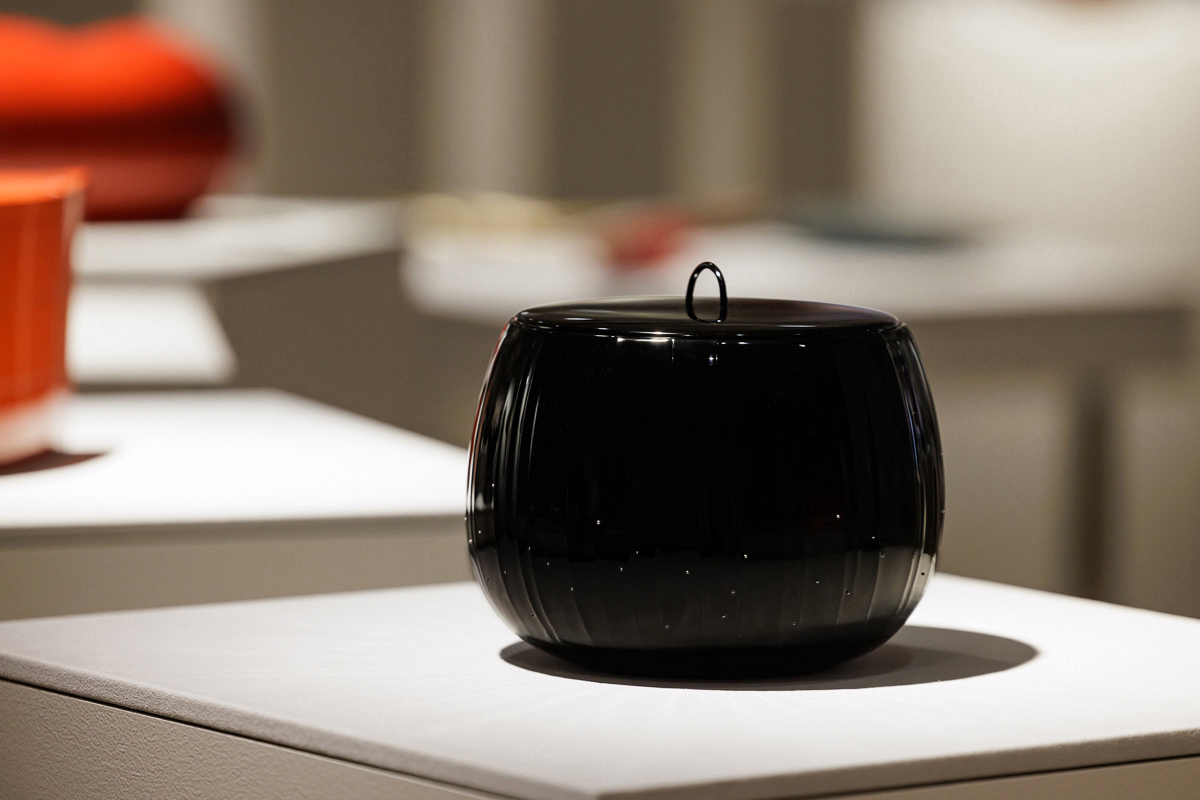
Dry lacquer water container "Falling everywhere" ⌀20 x h17.5cm
Okui's lacquerware techniques were honed in Wajima, Ishikawa Prefecture, a leading center for lacquer art in Japan.
"After graduating from university, I underwent a five-year training program at the Ishikawa Prefectural Wajima Lacquerware Technical Training Institute. Following that, I was accepted into the workshop of Ms. Kazumi Murose, where I learned a great deal. Not only was I able to observe her techniques firsthand, but she also worked on the restoration of cultural properties in addition to creating her own works, allowing me to encounter numerous wonderful pieces. These experiences have become invaluable. And I learned the importance of never giving up on my work or my craft."
Okui currently has a studio in Yokohama where she continues to create her work.
"When people think of lacquerware, they tend to imagine things like bowls and tiered boxes, but I hope that more people will learn that there are also these kinds of free and fun shapes. While cherishing the beauty of traditional utility, I would like to work on a variety of other projects as well."
"Ayaori-gane." Beautiful patterns created by woven flat metal wires. —Metalwork by Takahiro Iede—
There is a type of woven fabric called "twill weave." It is a unique weaving method in which the points where the warp and weft threads intersect are diagonal, and it is often used for jeans and coat fabrics. Takahiro Iede's series of works, which he has named "Ayaori-gane," apply this technique to metal.
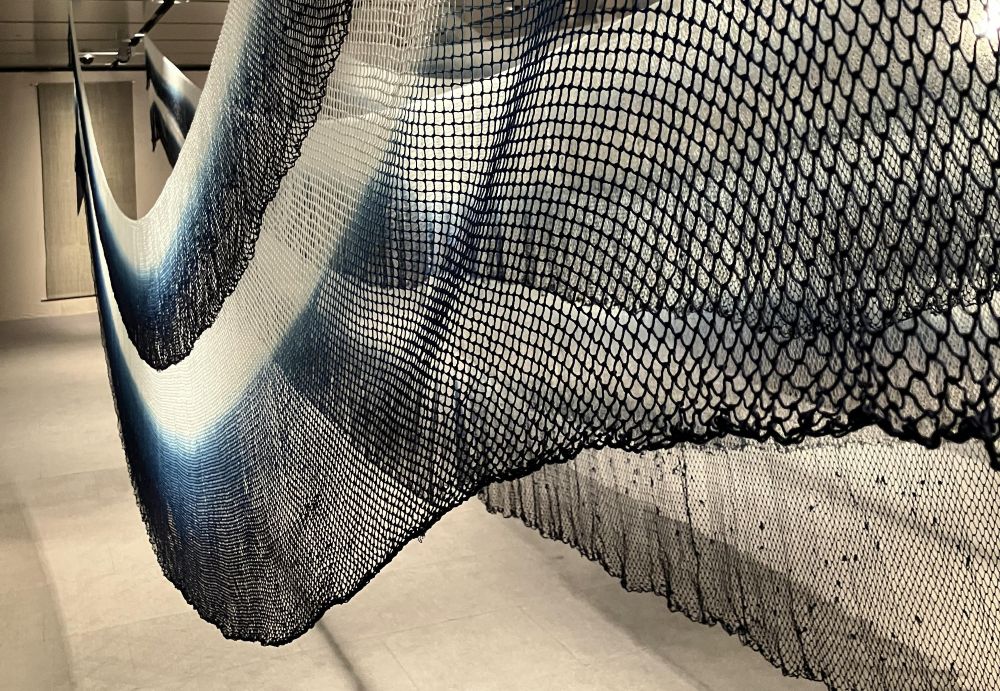
Various metals, including copper itself, "shakudo" (copper with about 3% gold added), and "shibuichi" (shakudo with 25% silver added), are processed into thin, flat wires. These wires are then woven together like a twill weave to form a plate, which is then fused together with silver solder and shaped into a three-dimensional form using metalworking techniques. The resulting artwork truly resembles knitting. The intricate patterns created by the intersecting thin plates of metal of different colors have an exotic, mosaic-like quality, yet the unique patterns characteristic of knitting evoke a sense of nostalgia.
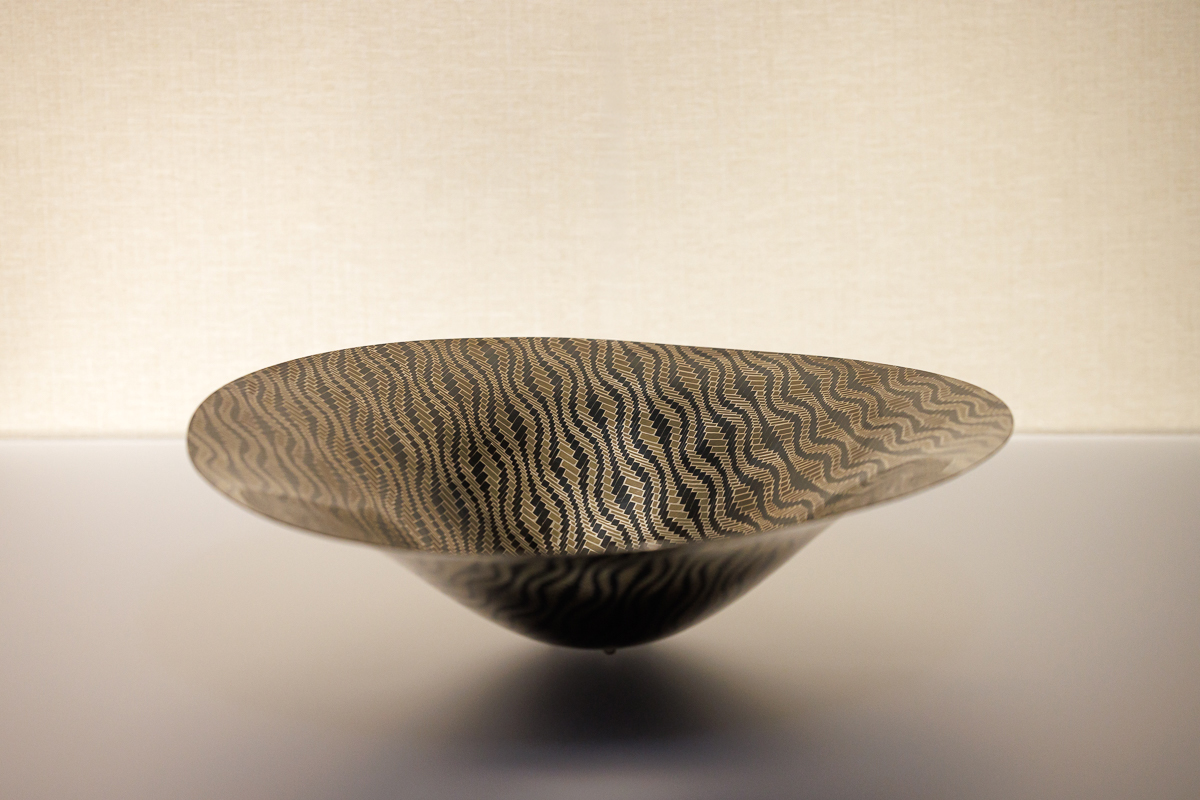
Ayaori-gane pottery "Hayase" W42×D41×H12cm
"Metals inevitably have a hard, inorganic image. I wondered how I could break away from that, and through trial and error, I arrived at 'Ayaori-gane' by weaving thin strips of metal to give it an organic warmth. I think I'm probably the only one using this technique, and I don't think there are any examples of it anywhere in the world, past or present, not just in Japan."
The inside and outside of the large vessel, which is big enough to be embraced, are rhythmically arranged with regular patterns created by weaving, and these patterns harmonize well with the generous form of the vessel.
"Standing Tall," an object with a mysterious presence.
The venue also features some unusual and intriguing sculptures. One piece, titled "Standing Tall," is essentially a metal weave. Upon closer inspection, numerous flat wires are intricately woven together, and the ends, which are left long and not woven, are deliberately cut to varying lengths. In a sense, it captures the intriguing nature of metal before it becomes a finished product such as a vessel.
Standing literally upright on an acrylic base, the flat metal wire used is undeniably inorganic as metal, yet its tips tremble delicately with even the slightest vibration, making the work itself appear almost like a living organism. Unlike other metalwork pieces that possess a gentler expression, this work stands apart as contemporary art, stirring ripples in the viewer's heart and approaching them with a mysterious sensation.
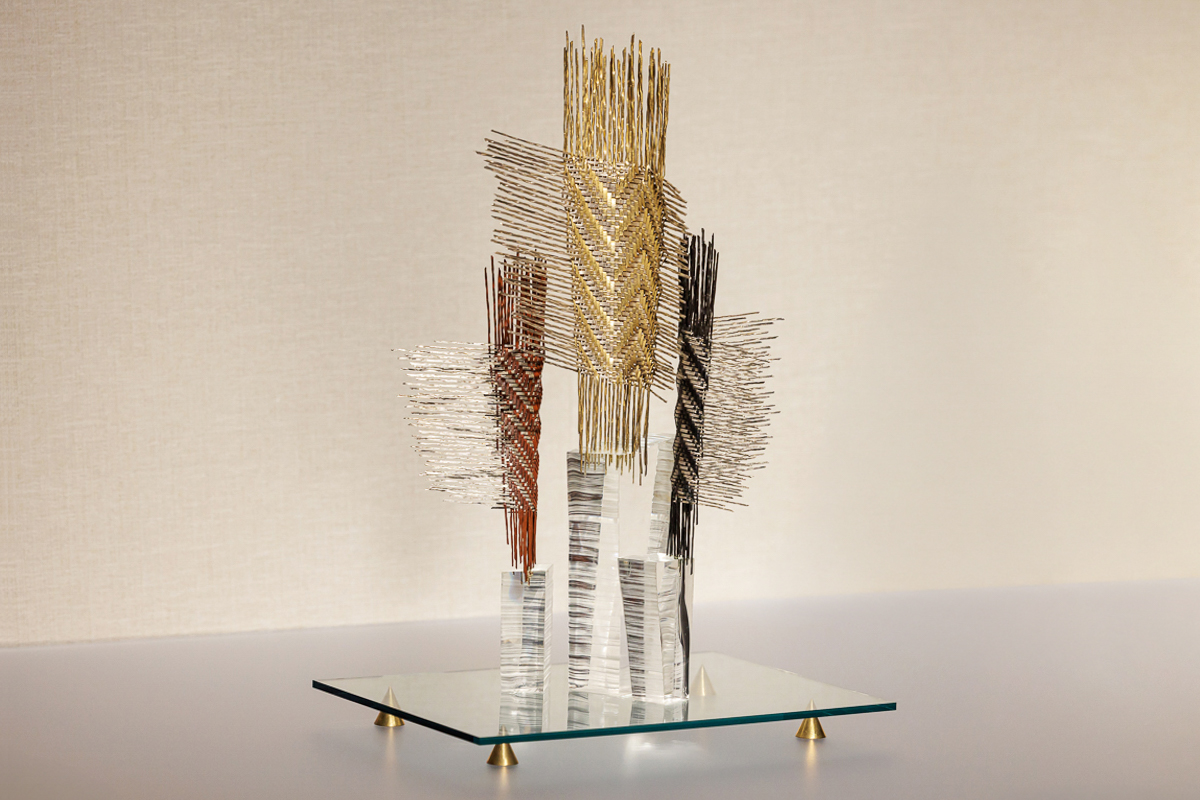
Ayaori Gane "Standing Tall" W22×D26×H42cm
"Based on differences in expressive styles, the 'Ayaorigane' series is divided into three types: 'Shin, Gyo,' and 'So.' 'Kiritsu' belongs to the 'So' category. In all three 'Shin, Gyo,' and 'So' works, the individual flat square wires are woven together, influencing each other to create complex and beautiful patterns. A single flat square wire is, after all, inorganic and uninteresting. But it is through their relationships with each other that they enhance each other and are elevated to beauty."
Seeking the new beauty that can be brought forth by the encounter of metals, Iede continues to knit.
The harmonious blend of wood grain and inlay ──Wood - Akio Watanabe──
"In woodworking, the key is how much of the inherent beauty in wood, a gift from nature, you can bring out. Therefore, I try to preserve the beauty of the wood grain as much as possible, and keep inlay to a minimum. That's my approach to creating."
Akio Watanabe speaks in front of a display of his elegant box-shaped works. Ancient zelkova, black persimmon, walnut, cherry... He uses a variety of woods as materials, but in each case, he carefully examines the grain from the lumber stage and uses only the parts that have been meticulously selected for his works.
"There's actually a bit of a dilemma when it comes to adding inlaid patterns to beautiful wood grain. So, when I do use inlay, I do it effectively on simple straight grain. If the wood has a lot of complex grain, the patterns cancel each other out, resulting in both being detrimental."
The effectively placed inlay work harmonizes with the beauty of the straight grain, enhancing the piece. The small blue-green dots scattered on the lid of the small box are made by dyeing deer antlers with rokushō (a pigment used in Japanese painting), then embedding them in small granules—a technique that has been used since the Nara period. The elegant patterns depicted in the inlay also resemble arabesque patterns, reminiscent of designs from the Nara period.
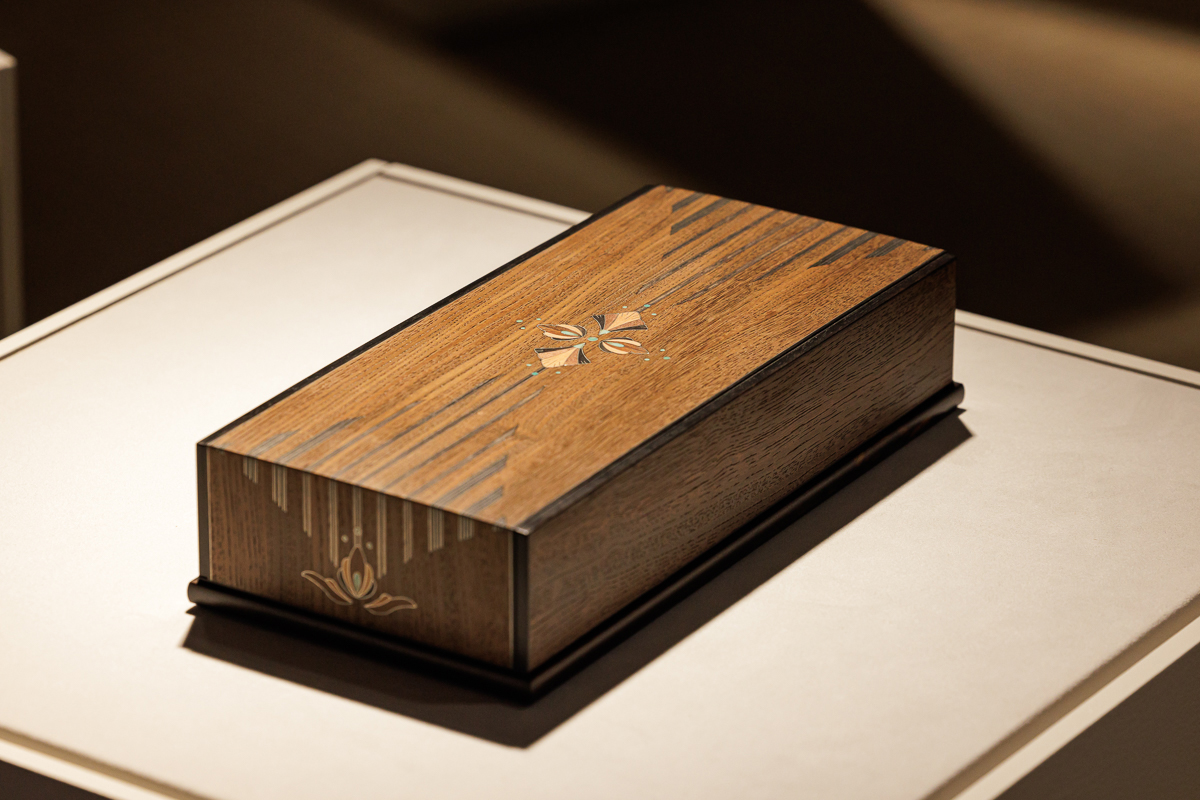
Ancient Zelkova wood inlaid box, W30.5 x D14 x H6.5cm
"I often visit Nara to study ancient patterns found in treasures such as those in the Shosoin Repository, and I incorporate those into my work. I like the bluish-green color of deer antlers dyed with verdigris, and I use it as an accent like this, but it's actually a very time-consuming material to dye, taking many years."
The source of the grace and elegance emanating from Watanabe's work lies in the beauty of the Tenpyo era. However, at the same time, the sharp lines give it a modern appearance. These lines, too, are actually created using the marquetry technique.
Each line is an astonishing 0.14 millimeters wide. Seven to nine of these thin lines are arranged in sets, adorning the lid and sides of the piece. The refined inlay work, born from a struggle to perfection, combines with the beautiful straight grain of the ancient zelkova wood to create a noble and exquisite world of art.
Upon opening the lid, the world transforms into an elegant golden realm.
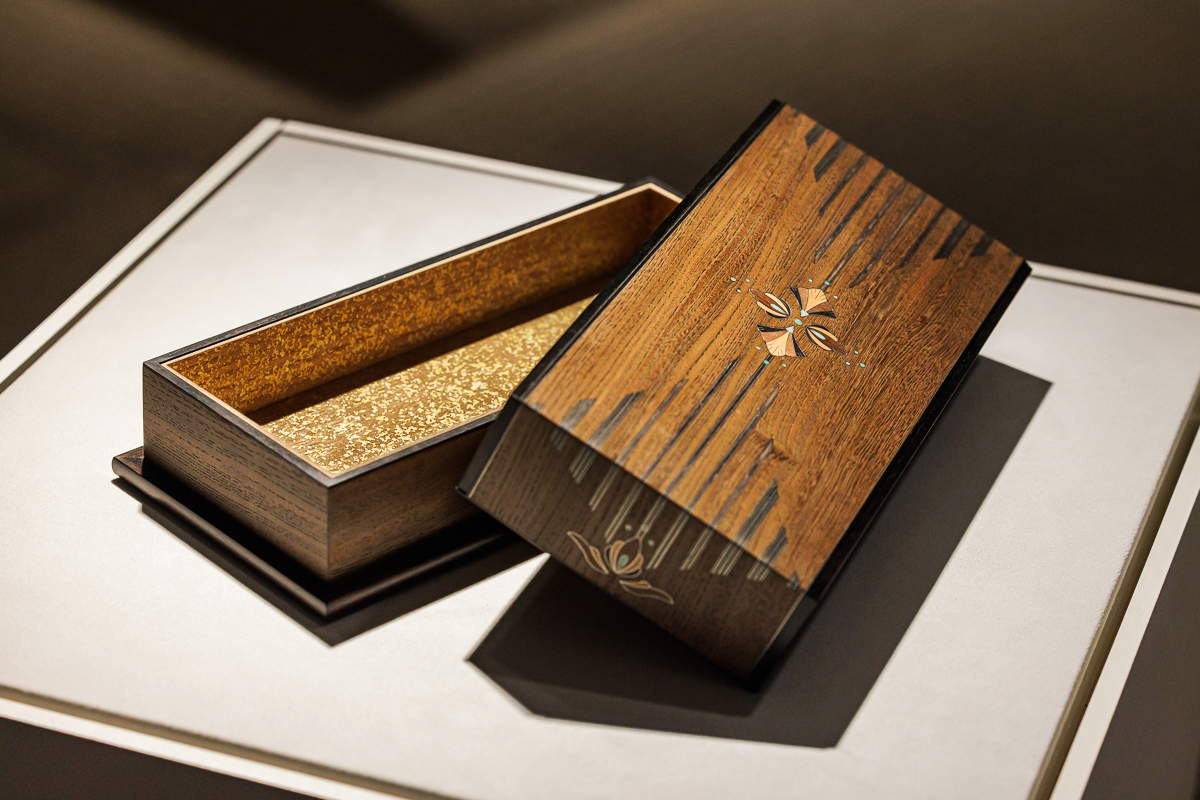
Ancient Zelkova Wood Inlaid Small Box
Upon opening the lid, a dazzling world of gold suddenly appears. The underside of the lid and the interior are lavishly adorned with gold flecks, creating an elegant and refined atmosphere. The contrast between this world and the restrained exterior of the lid is truly astonishing.
"I believe that paying attention to these kinds of details is what makes Japanese crafts so wonderful, and incorporating such meticulous care is a source of joy for me as a craftsman."
Last year, Mr. Watanabe was designated a holder of the Important Intangible Cultural Property "Woodworking," meaning he was a Living National Treasure. He spoke with a smile and seemed to enjoy describing the expressions he had applied to the inside of the lid and the interior of the container.
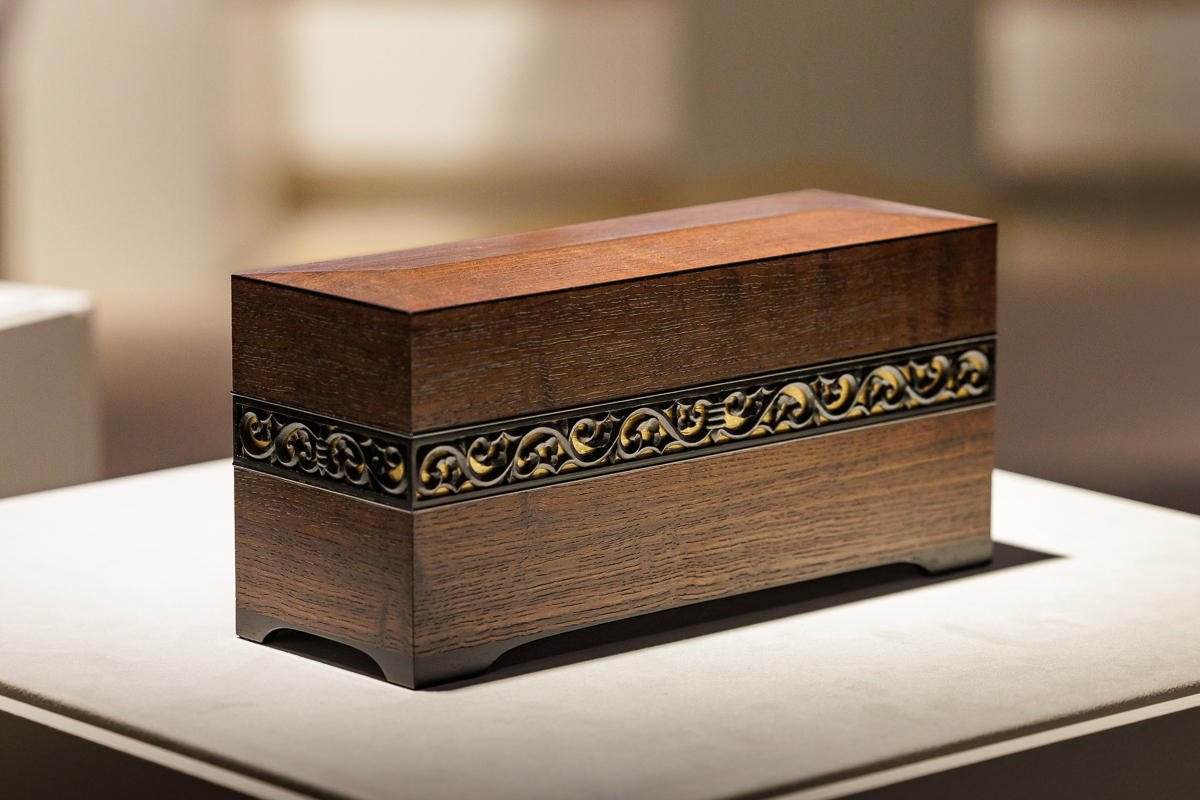
Ancient Zelkova wood box with arabesque pattern, W27.2 x D9.7 x H13cm
◆Art exploration diary ~ Exhibition information
"Four-petaled flower, fragrant II: Glass, lacquer, metal, wood"
Date: Thursday, September 10, 2026 - Wednesday, September 23, 2026
Time: 11:00 – 19:00 until 17:00 on the last day
- Location: Seiko House 6th floor Seiko House Hall

Interview and composition: Masao Sakurai
Former Deputy Editor-in-Chief of Fujin Gaho magazine. She was responsible for covering and writing articles on various aspects of Japanese culture, including traditional crafts such as pottery and lacquerware, as well as tea ceremony and Kabuki. Currently, she works as a freelance editor, involved in the production of books, magazines, and advertisements. For Premium Japan, she mainly writes articles on traditional crafts and travel.
Photo by Kayo Takashima
Lounge
Premium Salon
Art exploration diary - exhibition impressions...


Premium Salon