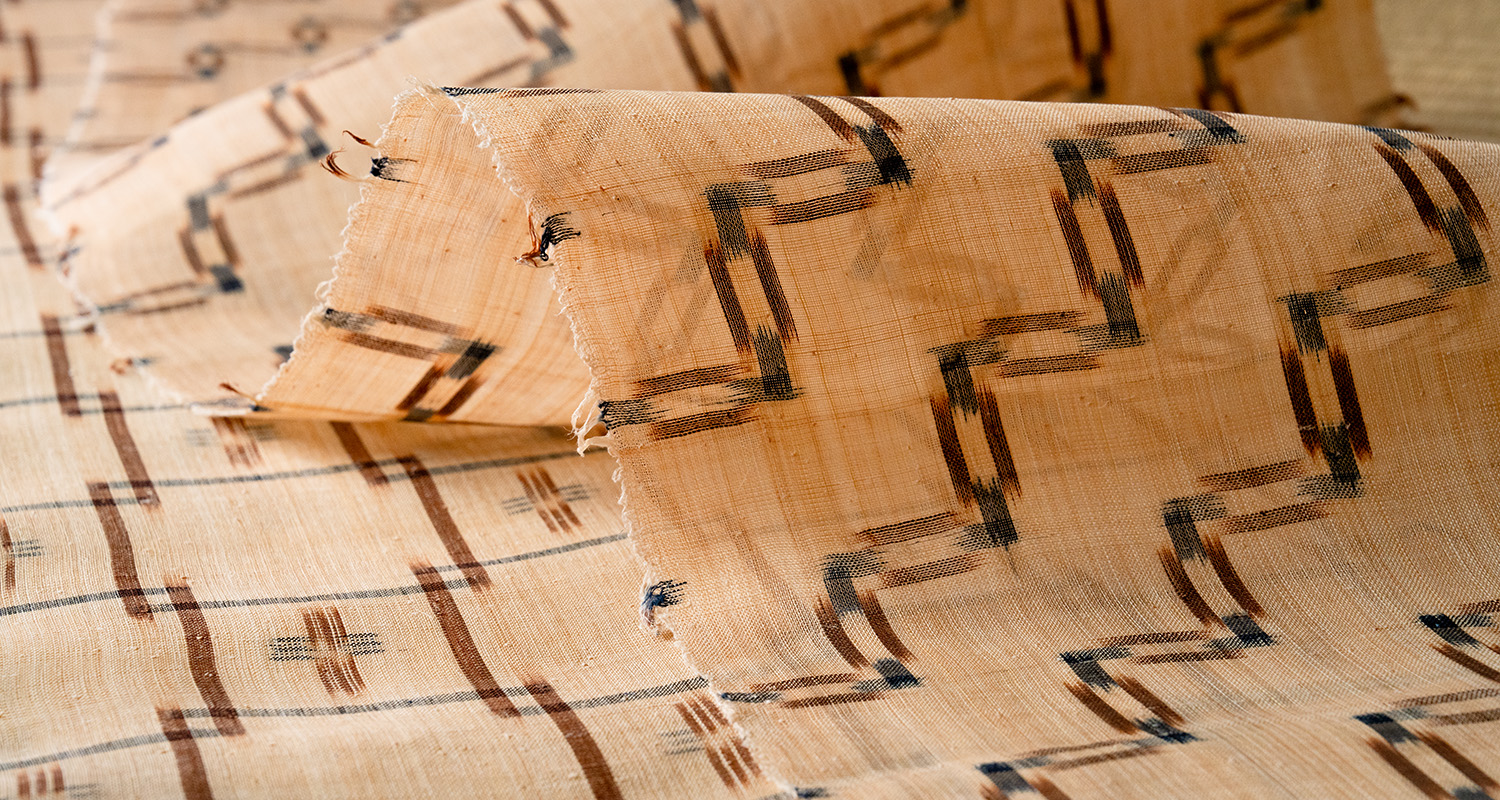
There is a fabric called "Bashofu." Kimono woven from this fabric, which has a cool, light, transparent feel and a unique crisp texture, were worn not only by the royal family of the Ryukyu Kingdom,It has long been cherished as the quintessential attire of tropical Okinawa, worn even by ordinary people. However, the production of bashofu, which was once carried out throughout Okinawa, has gradually disappeared in recent years, and it has become a rare commodity, now produced almost exclusively in Kijoka, Ogimi Village. Furthermore, due to its rarity,
Every step of the process is deeply connected to the natural environment of Kijoka, resulting in a unique fabric.
About an hour and a half's drive from Naha Airport, Ogimi Village is located in the northwestern part of Okinawa Island, facing the endlessly blue and beautiful sea. Near the northern end of this long, narrow village lies Kijoka. This small settlement, with a population of only about 400 people, is a production center for banana fiber cloth.
Bashofu, which was designated a National Important Intangible Cultural Property in 1974 (Showa 49) and a National Traditional Industrial Product in 1988 (Showa 63), is actually designated as "Kijoka Bashofu," with the place name included. The reason it is named with the place name rather than simply as "Bashofu" is that all processes, from the agricultural work of cultivating the raw material, the banana plant, to extracting the fibers from the harvested banana plant, dyeing them, and weaving them, are inextricably linked to the natural environment and local community of Kijoka.
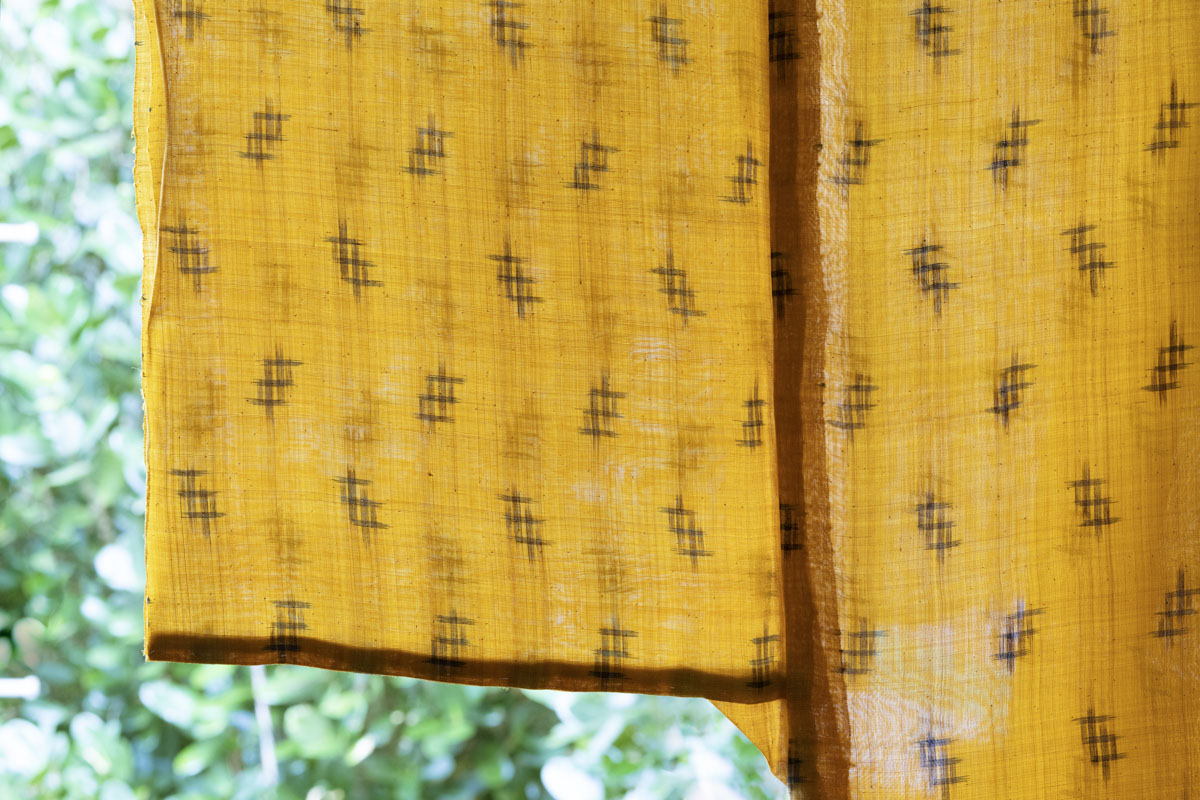
Its crisp texture and lightness evoke a feeling of coolness, and its unique yellow hue stands out beautifully in the bright sunlight of the tropics.
In Kijoka, the "Kijoka Banana Cloth Business Cooperative" is operated with the aim of developing the production of banana cloth as an industry. I traveled to Kijoka to ask the chairperson, Mieko Taira, about the current state of banana cloth in Kijoka.
A cooperative is a corporate organization formed to improve the efficiency and performance of a business.
Turning off the coastal highway onto a side road, you'll find Mr. Taira's privately run workshop. Mr. Taira, the chairman of the association, is also the representative of the workshop. But what exactly is this association? I asked Mr. Taira.
"This is a corporate organization formed by individual business owners, artisans, and others cooperating with each other to improve the efficiency and quality of their businesses. In Kijoka, for example, each member craftsman is a business owner, and their workplace is their home. This workshop is also one of the businesses that make up the cooperative."
The cooperative, established in 1984, once had around 150 employees, but now has only about 60. Like many traditional craft producing regions, Kijoka faces the problems of a shortage of successors and an aging workforce.
Bashofu is a high-quality fabric, often described as having "the transparency of a cicada's wing, and being cool and light." However, the numerous processes required to produce this quality are one of the factors hindering the emergence of new artisans.
Making banana fiber cloth starts with farm work.
Kijoka banana fiber cloth is made from thread. That's a major difference from other production areas. The raw material is the banana plant cultivated in Kijoka. The process begins with peeling the bark off the banana plant, which has been grown for about three years, and then extracting the fibers to make thread. Mr. Taira describes the hardships of this process as follows:
"A single banana plant yields about 5 grams of high-quality thread. Approximately 1 kilogram of thread is needed to weave one bolt of cloth, so 200 banana plants are needed per bolt. This requires proper cultivation of the banana plants. The saying 'Banana cloth making starts with farm work' comes from the fact that this cultivation work is the first and most arduous step."
"When people think of weaving mills, they tend to focus only on the work on the looms, but with Kijoka banana fiber cloth, the weaving process accounts for less than 1% of the whole. From cultivating the banana plants to the completion of the cloth, it goes through approximately 23 steps, all within Ogimi Village."
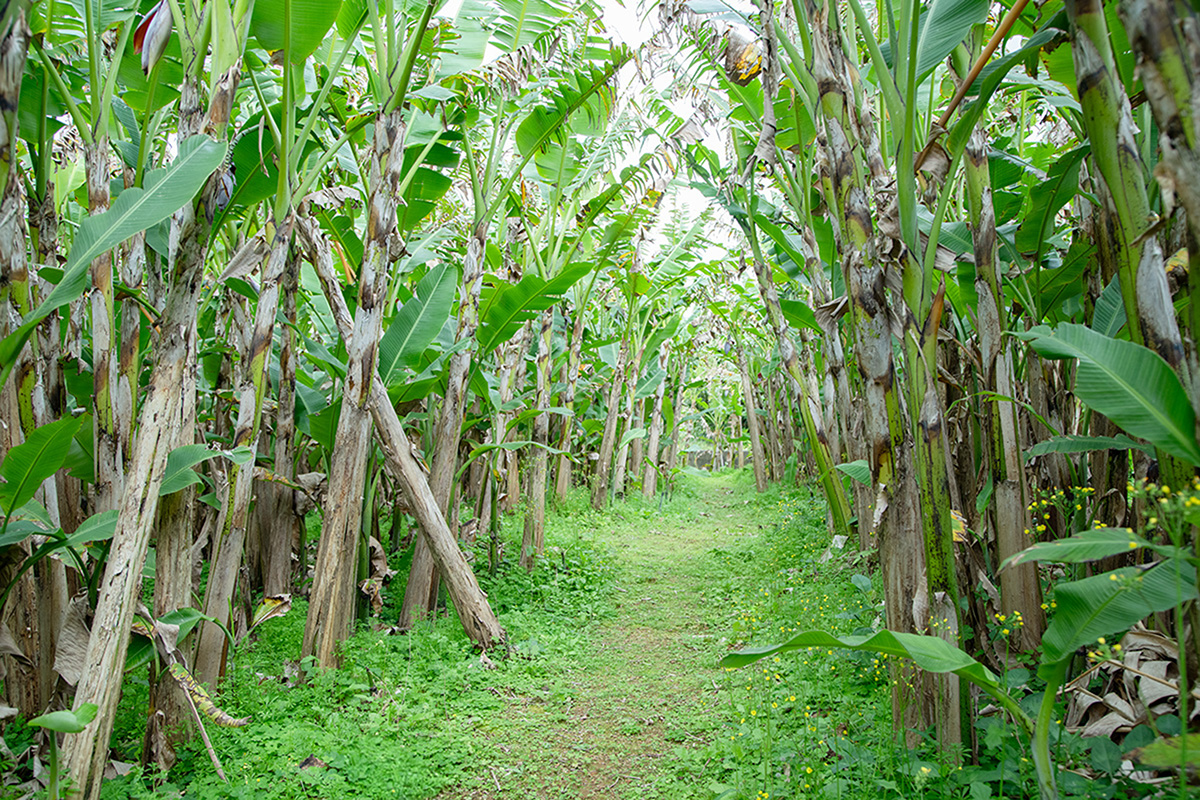
Fields of banana fiber cloth are scattered throughout the Kijoka settlement. The cooperative manages approximately 2000 tsubo (about 3 square meters) of fields. (Photographed in March 2025)
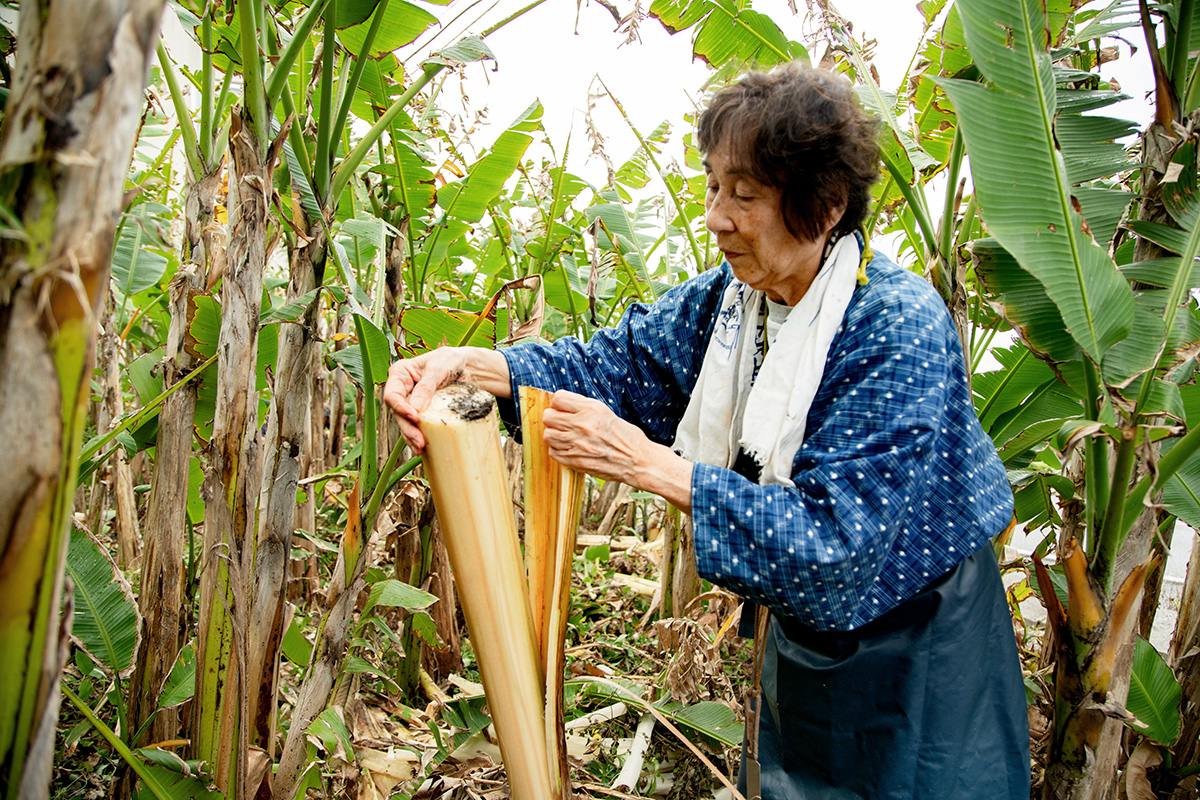
Mr. Taira is performing a process called "u-hagi," carefully peeling the outer layer of the banana plant's bark. The inner fibers are softer and produce higher-quality thread. Harvesting is mainly carried out from autumn to winter. (Photographed in March 2025)
Currently, in Japan's textile industry, the majority of production involves importing cotton and silk threads from overseas and weaving them in mechanized factories. However, Kijoka's banana fiber cloth (bashofu) continues to be made using methods that have remained unchanged for hundreds of years, starting with the cultivation of the banana plants used as the raw material for the thread. These laborious processes, not seen in other production areas, are carried out continuously, and it is this that produces the superb quality of bashofu.
The fibers are split into thin strands, and each one is tied together with the fingertips to form a long thread. This mind-numbingly painstaking work is continued in silence.
Miyagi Ryoko and Yamakawa Chizuko, both members of the cooperative, had come from their homes to work in Taira's workshop. Both live in Ogimi Village, and their homes are very close by. They used to have looms at home and worked as weavers, but the physically demanding work of weaving has become difficult as they have gotten older. However, in the production of bashofu, which requires numerous steps, there are still many opportunities for their experience and skills to be put to good use.
The process Miyagi was performing is called "u-umi" (苧紡み). "U" refers to the fibers, about one meter long, extracted from the banana plant. "Umu" means to split these fibers into thin strands, tie them together one by one with the fingertips, and connect them to form a long thread. This process of connecting the thin fibers with tiny, unbreakable knots requires the most skilled technique of the entire process and is time-consuming and laborious.
Ms. Miyagi silently moves both hands, splitting the hemp fibers into thin strands and tying them together. Even watching her work, it's impossible for an amateur to understand how she's tying the knots. All you can see is that the threads are slowly but steadily stretching out and fitting into the bamboo basket placed beside her. Ms. Taira explains how difficult the process is.
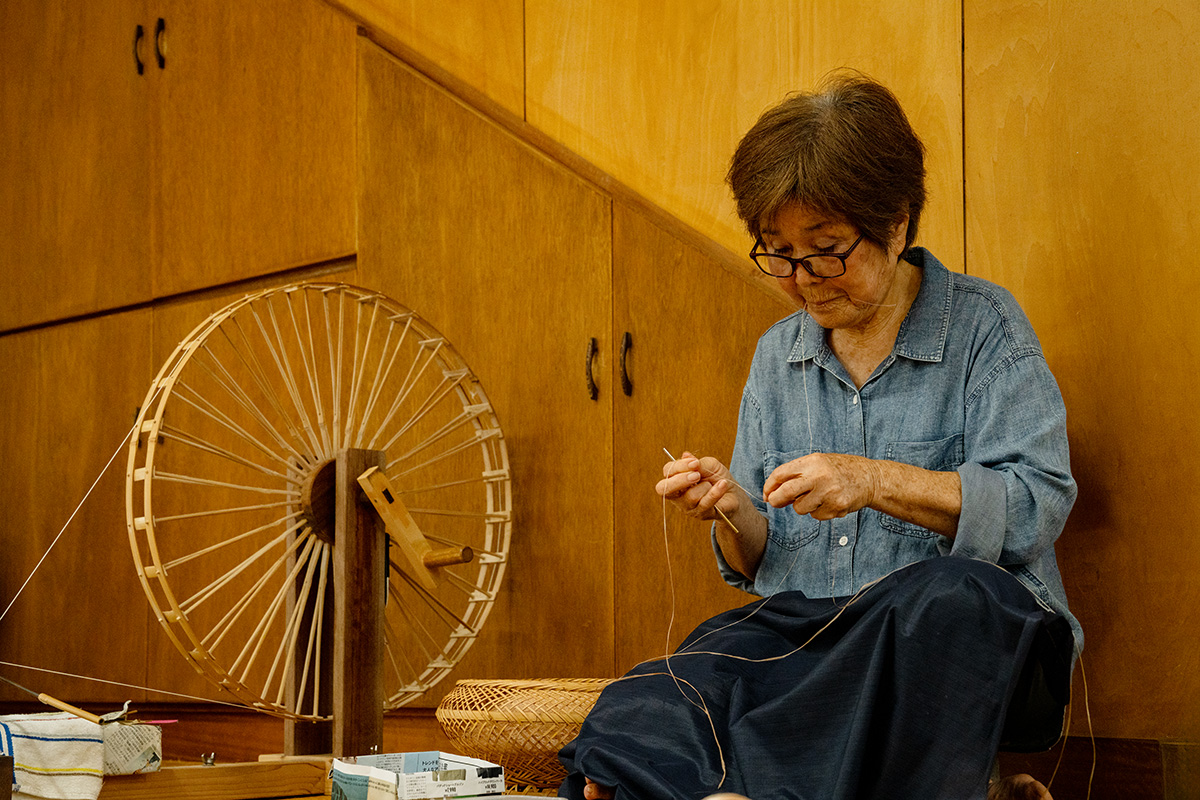
Ryoko Miyagi continues her work of spinning ramie in silence. To make it easier to distinguish the lighter-colored threads, she places an indigo cloth over her lap.
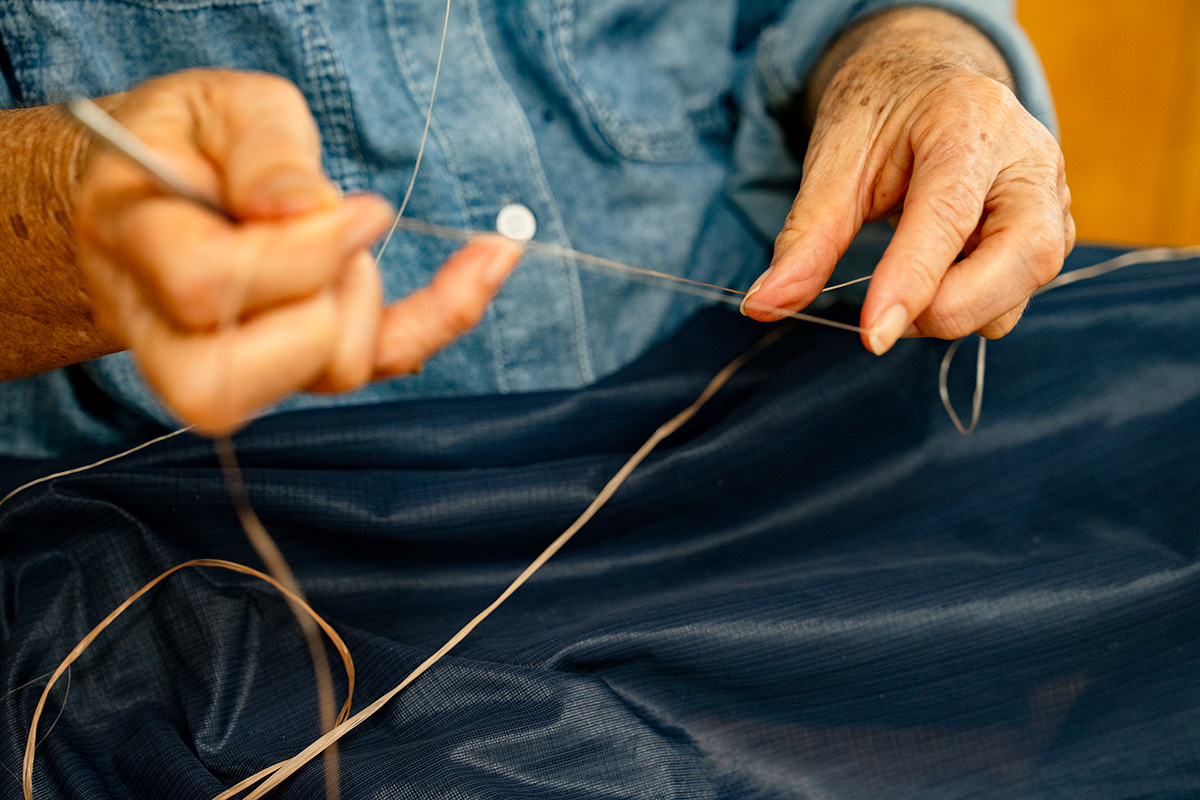
The finely torn hemp fibers are tied together using only the fingertips. A safety razor is held in the right hand to tighten the knots.
"When a veteran like Ms. Miyagi spins the ramie all day, she can produce about 20 grams of thread. The amount of thread needed for one bolt of kimono is said to be around 800 grams, so it takes an incredibly long time. In the past, the grandmothers of Kijoka would gather together, chatting away while diligently spinning the ramie."
The thread is wound onto a bamboo frame. This "thread winding" process requires delicate control of force.
Two poles are set up along the wall of the workshop, about five meters apart, and many threads are threaded between them. A process called "thread winding" is being carried out, in which threads dyed yellow using a plant called Fukugi are wound onto a bamboo frame.
If "hemp spinning" is a static task, then "thread winding" is a dynamic one. Walking quickly back and forth between poles, the worker rhythmically rotates her right wrist to wind the thread. While it may seem like a simple task, it requires delicate control of force to ensure even tension and prevent tangling and breakage before the thread is placed on the loom. The person involved was Chizuko Yamakawa. She stopped working and began to explain.
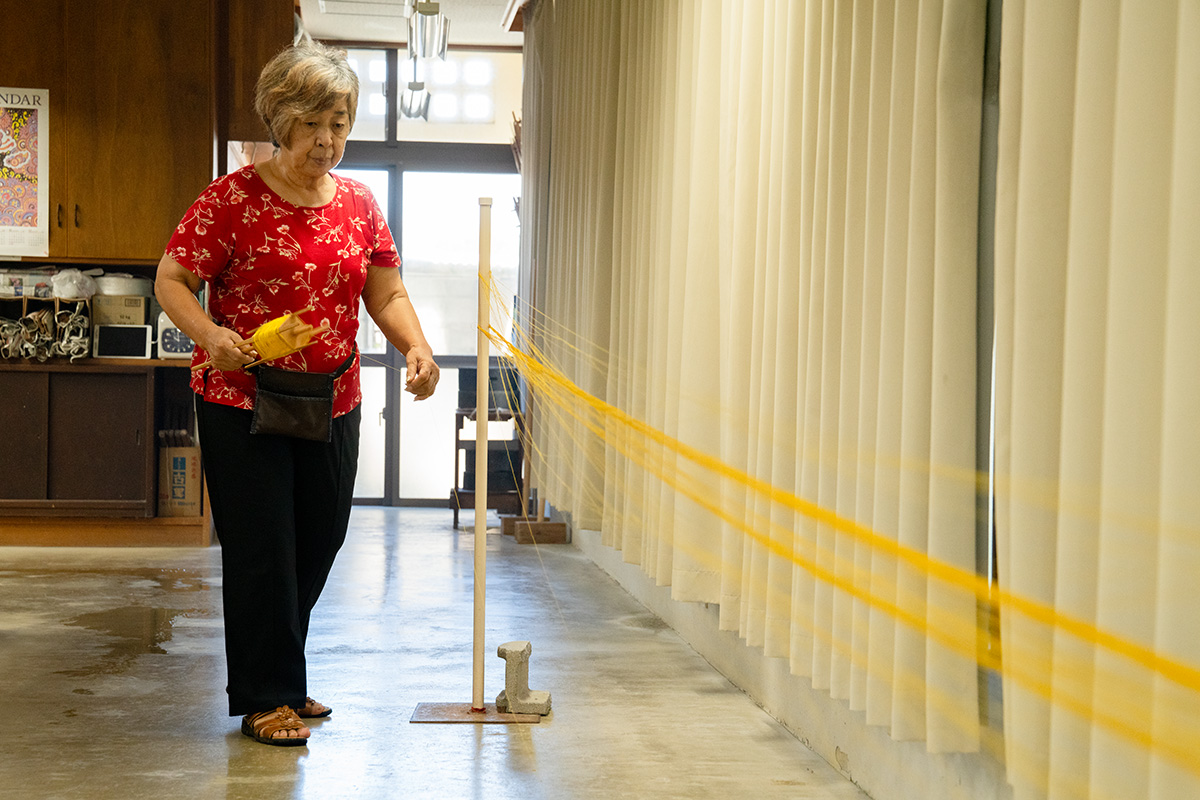
The "spinning" process involves moving quickly on foot and rhythmically using the right hand to wind up the thread.
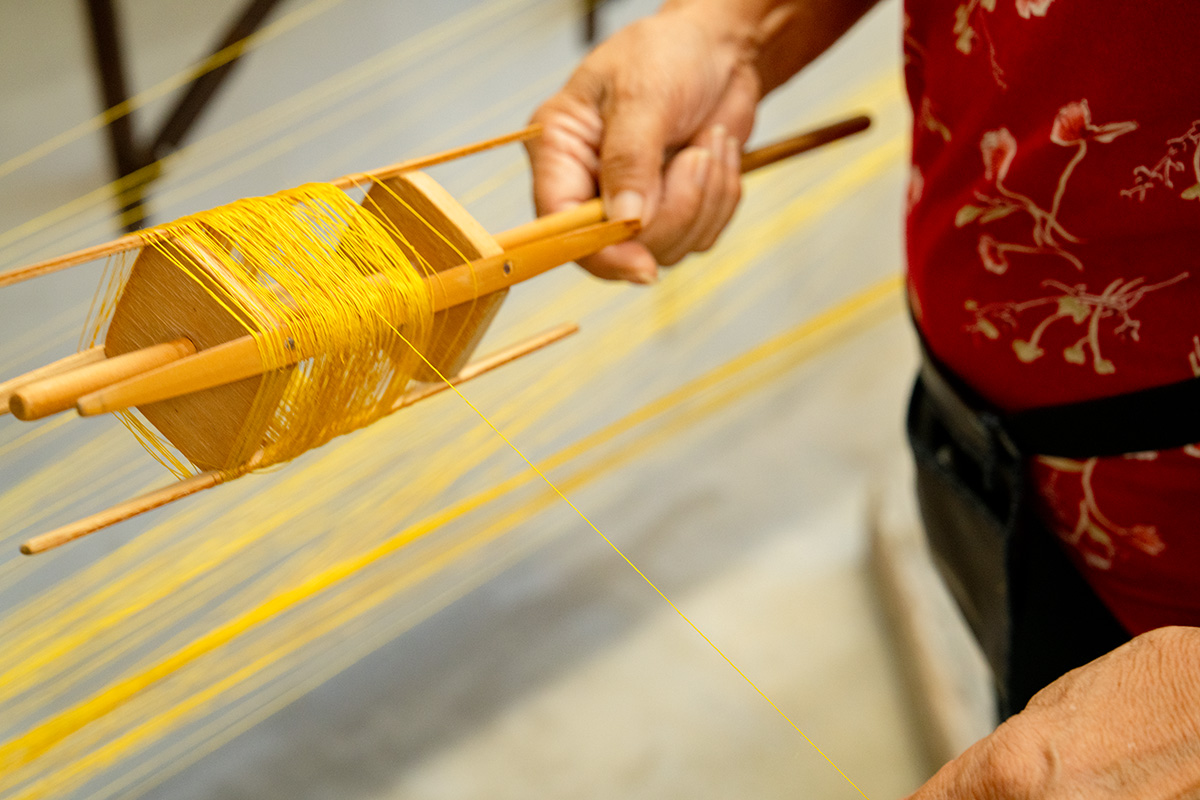
Although it may seem like a simple task at first glance, winding the thread quickly and with uniform tension requires skilled technique.
"When you're spinning the thread, you can easily tell whether the ramie has been carefully spun or not. When you're spinning the ramie, you can easily tell if the preceding process, called 'udaki' (boiling the ramie in lye), has been done properly. They say that at the 'udaki' site, you can immediately tell whether the banana plants used for spinning were carefully cultivated. In the end, everything starts with properly growing the banana plants, and that influences every step of the process that follows."
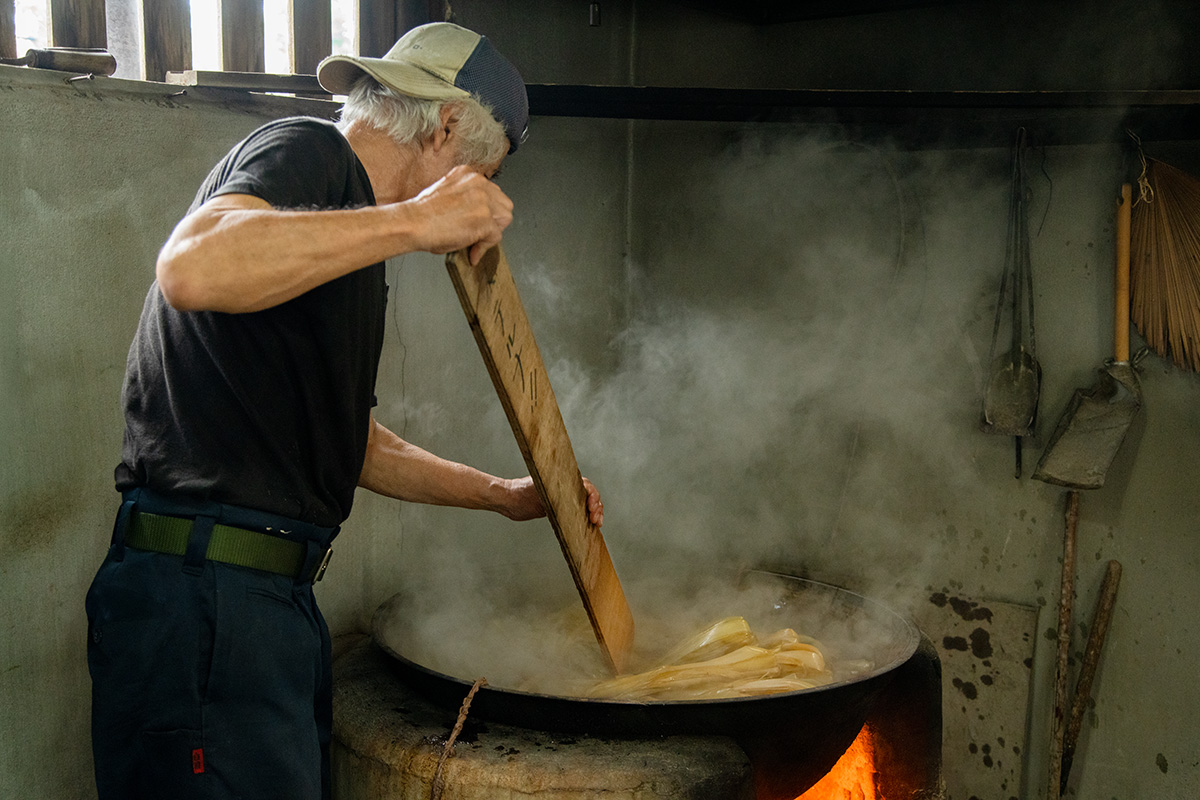
"Odaki" is the process of boiling ramie in lye. Because it's such physically demanding work, men are now also involved in this task. (Photo taken March 2025)
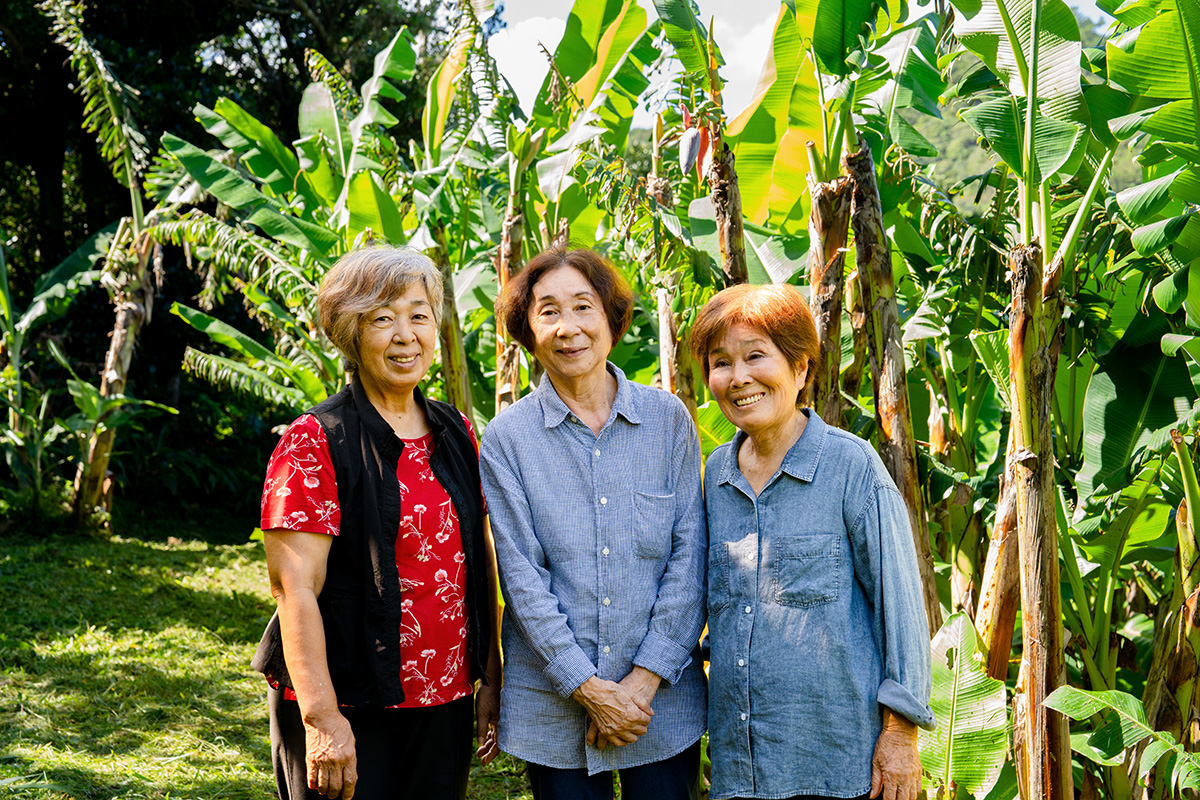
Taking a break from their work, they went to a field of banana fiber cloth nearby the workshop. From left to right: Chizuko Yamakawa, Mieko Taira, and Ryoko Miyagi.
Although they no longer sit at the looms themselves, the two still work in Taira's workshop, taking on some of the many processes involved, and instructing the younger staff members who work there. This is how the traditional techniques are passed down.
A newly established field of banana plants on the slopes of Kijoka Mountain.
While Mr. Taira is concerned about the current state of Kijoka's banana fiber cloth, he is also exploring new possibilities.
"The fact that it's designated as a traditional craft in conjunction with the place name Kijoka is, in some ways, a hindrance. Because it's associated with the name of a small settlement, everything from cultivating the banana plants to their final product must be completed within this area. While it's fortunate that the place name is attached to it, trying to fulfill all the requirements within this district alone presents various difficulties. It's not just a matter of manpower; even when it comes to banana plantations, there's a limit to the area that can be cultivated within this immediate vicinity."
With this in mind, Mr. Taira established a new field of banana plants last year on the high-altitude mountainside within Kijokanai, an area where cultivation had not been done before.
"The quality of the banana plants, like that of vineyards used for winemaking, depends on the soil of the field. From what I've seen, the soil in this mountain field seems suitable for cultivation, and because it's at a certain altitude, it should be spared from tsunami damage."
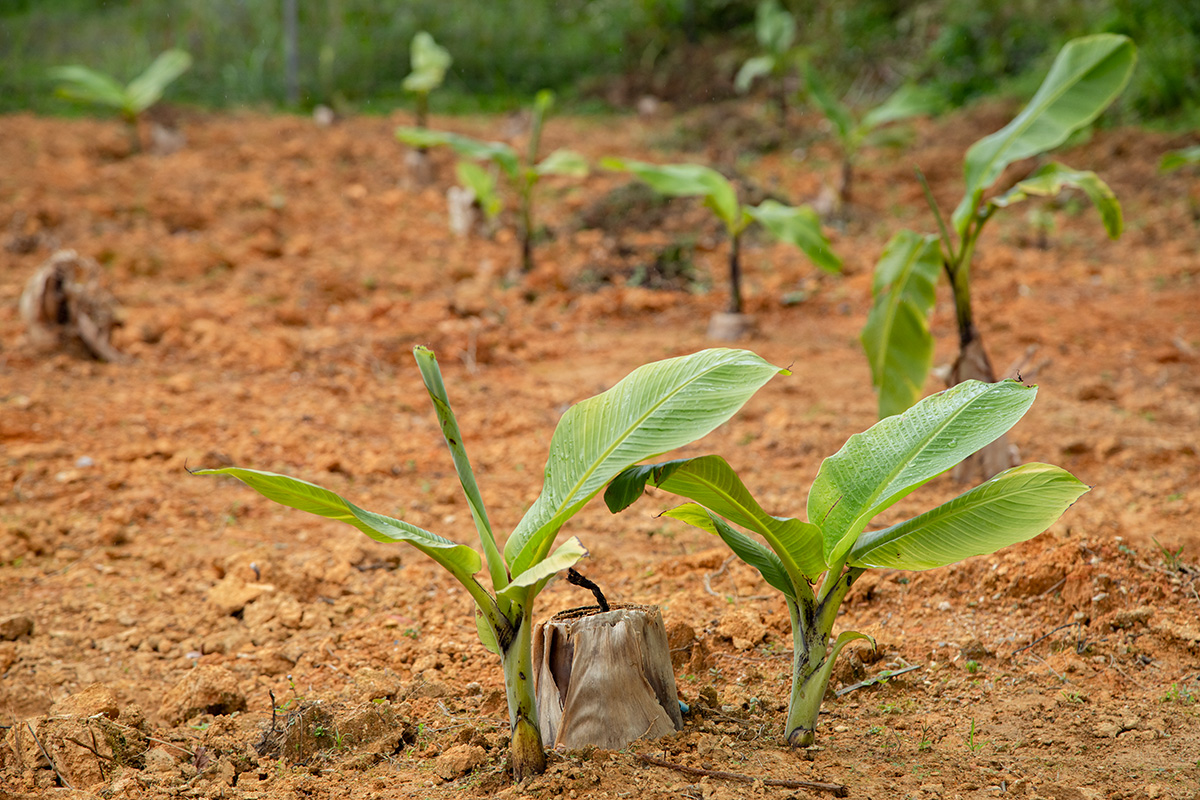
Young banana sprouts emerging in a mountain field. To explore new possibilities, cultivation is being attempted in areas previously not used for farming. (Photographed March 2025)
To raise awareness of Kijoka's banana fiber cloth, exhibitions are also held overseas.
While Ms. Taira herself is involved in various processes, including "hemp spinning," she also travels not only throughout Japan but sometimes overseas to hold workshops and exhibitions, dedicating herself to raising the profile of Kijoka banana fiber cloth.
"When we hold exhibitions and people see the actual banana fiber cloth, everyone can truly appreciate its beauty. However, when they learn the price, they say, 'Wow, that's expensive!' It is indeed expensive, but considering the incredible amount of effort involved in making Kijoka banana fiber cloth entirely by hand, without using any electricity, it's understandable that it's somewhat pricey. High-end cars like sports cars are expensive because they have superior performance and are worth the price. I hope people can understand that it's the same principle."
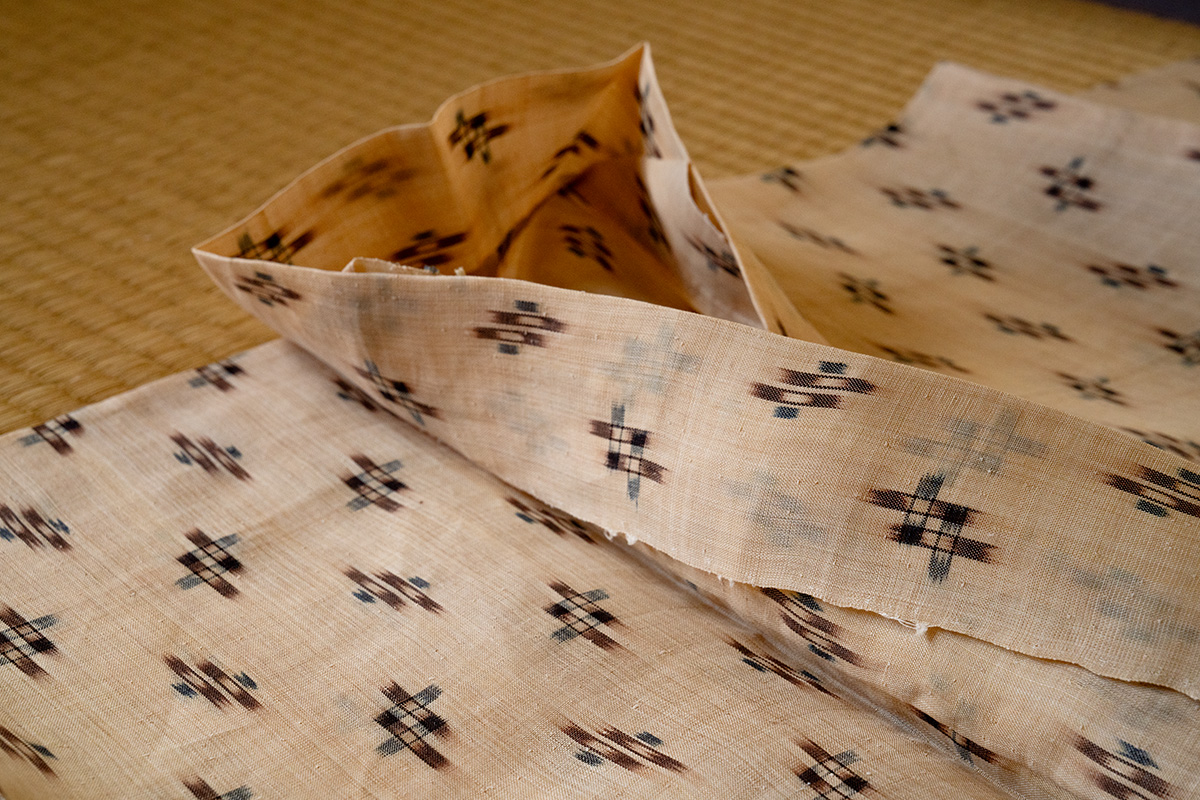
A kimono made from banana fiber that has been partially tailored. "By holding exhibitions and workshops, I hope to let as many people as possible know about the wonderful qualities of banana fiber," says Taira.
The process of making banana fiber cloth can only be truly appreciated by visiting Kijoka.
A few years ago, Hoshinoya Okinawa proposed a program for guests to experience the wonders of bashofu (banana fiber cloth). The program involved guests wearing a bashofu haori (a type of jacket) called "unchanashi" within the resort grounds and experiencing its beauty firsthand.
After careful consideration, Taira accepted the proposal. However, he set one condition: the program had to include a visit to Kijoka, a trip to the banana plantation, and an opportunity to see firsthand the various activities taking place in the workshop.
"Simply touching the finished banana fiber cloth doesn't mean you understand it. It's only by experiencing the atmosphere of this Kijoka region, seeing the banana fiber fields, and observing the numerous processes involved that you can truly appreciate the beauty of banana fiber cloth and the immense effort required to create it."
The program has been realized, and is gradually helping to increase the recognition of bashofu (banana fiber cloth).
Mr. Taira has served as the chairman of the cooperative for many years. Like the other members, he has aged and is now in his late 70s, and is beginning to feel the effects of aging. However, he continues to work energetically every day to ensure that the cooperative continues to exist as a production center for Kijoka banana fiber cloth.
Photos by Azusa Todoroki (Bow Plus Kyoto)
JCCO
PREMIUM JAPAN AWARD
PREMIUM JAPAN AWARD 2026



PREMIUM JAPAN AWARD